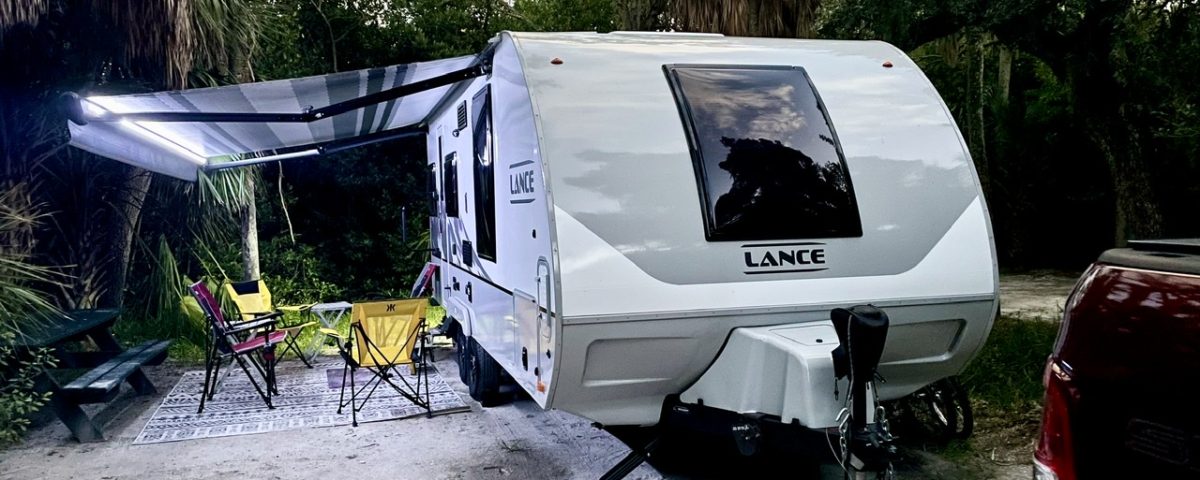
Our second year of camping has gone by so quickly. Our teardrop is a NuCamp 2017 T@G MAX XL and it has served us so well! This post is a summary of the miles we have traveled in the past year and the teardrop modification we have made.
Second Year Camping Trips
We only took six camping trips this past year, which does not sound like a lot for a retired couple. However, two were monthlong trips and one included three stops. We hauled our teardrop 10,451 miles—three times the miles traveled in our first year. We revisited three nearby states, but also camped in thirteen new states. Our hope is to eventually camp in every state.
The trips included 36 different campgrounds and 75 nights away from home. We were inexperienced newbies when we began camping two years ago. Now, I think of us as seasoned campers.
Below are links to the plans for our two monthlong trips. Our first one was out west during the winter and the second was a summer trip north. Those trips were so amazing!
Our camper is so well designed that we have not needed much in the way of teardrop modification. Our mods were really just minor changes to increase comfort and functionality of the camper.
Heater Stand
This may not technically be considered a modification because everything is removable. We needed a heater for our winter trip out west; so we purchased a Honeywell HCE 100B Heat Bud Ceramic Heater. It has tip over protection, but we soon realized that we would need a stable surface for it to operate. A Facebook user had posted photos of a stand for a heater and my husband built one that was similar. The stand has proven to work very well.
Heater on Stand
The holes on the back panel enable the stand to rest very securely upon the door handles. There is a hole in the bottom panel for the cord to flow through to the electrical outlet. Lastly, there are two piano hinge to allow the stand to lay flat for easier storage in the cabinet when unused.
Heater stand
An added bonus, the stand works great for holding tablets that are being charged when there is no need for a heater.
Under Camper Storage Container
We needed a place to store my husband’s shoes and the inspiration for this teardrop modification came from another post on a Facebook group. It required drilling holes below the bed and mounting a track in which a plastic box can slide.
Under Camper Storage
This has worked well for the shoes. We store the bin in the cabin when we travel. We were concerned that we might forget to remove it when the camper is being pulled, but so far, so good.
Mesh Net Door Storage
We like to watch TV or DVDs before sleeping and I am the keeper of remotes. Before we did this teardrop modification, I was often searching for them. We have seen that other T@G owners have made this mod and at the rally in Ohio, we learned NüCamp is now installing mesh storage on the doors of new units. I love this mod!
Double Sided Velcro Strips
We used Velcro, but noticed the factory was using screws to attach the mesh pockets.
Mesh Storage on Door
When the door is closed, the storage pocket is just above the bed. We installed these on both sides.
Storage on Door
Storage Behind Television
This is another modification that many owners have made that is also included at the factory on new models. It involved removing the panel and putting hinges on the door. My husband finished the inside with particle board for ventilation purposes.
Storage Behind TVHandle installed to open doorFinished modification
Window Rail Brushes
We learned that nüCamp will provide rail brushes for the windows to prevent bugs from coming in. You have to install them, but it is not difficult. We obtained them at no charge from the parts department.
The photo below shows the side of the window without the rail brushes.
Window Rail Before Installation
The rail brushes installed below should be effective in keeping out insects.
Window Rail with Installed Brush
Conclusion
Our T&G has been wonderful this last year! The modifications we made primarily added a little more storage in key areas and we are happy with them.
In this next year, we are considering getting a bigger camper. The nüCamp 400 will likely be the replacement. However, it is hard for me to imagine loving any other camper as much as Endeavor.
Our reasons are simple. We now know how much we love to travel and are willing to take it to a higher level to have something that provides comfortable daytime space inside.
Our Indiana camping experience was excellent from start to finish. It was the last state we visited on our monthlong, four-state, camping trip. We loved Indiana and its natural beauty, plus all the wonderful things to do in the areas we visited. Below is link to the plan for our overall trip.
Our first Indiana camping was at Indiana Dunes for just one night, but we arrived early and had some time to enjoy the park. Our site was ideal—large, flat, shady, and just across from the bathhouse. The bathhouse was pretty new and also had a water source. Our site had electricity, but no water.
We took the walk to the beach. It was a good bit of walking for my husband’s bad knee, but we stopped and rested several times along the path. The walk was mostly shady and there was a boardwalk for much of the distance with places to sit, so it was not a bad walk.
Indiana Dunes boardwalk
The Dunes were very nice with hundreds of people, many swimming in Lake Michigan. I only put my feet in the water. The lake was warmer than the dunes farther north in Michigan, but still a bit cold for me.
The Dunes and Lake Michigan
The park was established in 1925 and the State later built an enormous pavilion. At one time, it held a soft drink parlor, grill room, two stores, and dressing rooms for beach users. Long ago, the pavilion had a hotel beside it, but it was removed in 1970. Currently, the building is locked up and unused, but it is my understanding there are plans to restore it. It is a lovely building and it is sad to see it unused.
There were newer changing rooms and restrooms next to the pavilion—very functional, but not nearly as grand!
Pavilion at Indiana Dunes
We returned to our site just barely ahead of a fairly strong thunderstorm., which we enjoyed from the comfort of our tiny camper.
Indianapolis
Big city Indiana camping was nice as well. We enjoy visiting large cities during our travels and Indianapolis beckoned. While we normally like to stay in public campgrounds, they are not usually close to larger cities. Lake Haven Retreat is located two miles south of Indianapolis and is also very near shopping and lots of nice restaurants, so it was very convenient.
Lake Haven Retreat Site # 53
We had a gravel site with a little shade and full hookups. While at this park, our camper was a baby among giants, some for extended stays. The bathhouse and laundry were a bit of a hike, but were very nice and well-maintained. We were quite comfortable during our stay at Lake Haven, but it was pretty hot. The one full day we were there, we left early and did not return till late afternoon.
Benjamin Harrison Home
We enjoy visiting Presidential libraries and museums. Benjamin Harrison has the distinction of being the twenty-third President of the United States and the only one from Indiana. Today, his Indianapolis home is a museum with tours that provide information about his life and presidency.
Benjamin Harrison’s Home
Harrison was from a political family; his grandfather was the ninth United States president. He was also the great grandson of William Henry Harrison, one of the signers of the Declaration of Independence. Harrison was president from 1889 to 1893, a time when the country was in the healing process after the Civil War.
Presidential Tour in 1892
Harrison and family members took an unprecedented train trip cross country during his term. (Seephoto above.) They traveled 10,000 miles in 31 days covering 21 states and delivered 150 speeches. He even visited our home city of Birmingham!
Piano in Library
The Harrison home has much of the original furnishings. That, plus the memorabilia and very informative tour guide made it very easy to get a sense of the life and times of this president. We were very glad that we had an opportunity to visit this presidential museum.
Museum of Art (Newfields)
Indianapolis is fortunate to have an amazing art museum. We arrived just in time for me to participate in a Gallery Tour, “Neoclassicism to Modernism”. My husband chilled with his tablet while I received a fabulous art lesson that included some of my favorite artists: Pissarro, Monet, Renoir, Seurat, Van Gogh, Cezannne, and O’Keefe. Heaven for me and relaxing for my husband. I will share some of the highlights of the tour.
Bouguereau’s Dream of Spring, 1901
The above painting is one of the later examples of Neoclassicism, which is characterized by idealistic forms, inspirational subjects, shallow space, Classical subject matter, and an utterly smooth surface without visible brushstrokes.
Millett’s Peasant with a Wheelbarrow
Realism (naturalism) came after Neoclassicism and the painting above shows how subject matter is represented truthfully without exotic or supernatural elements. The common man was often highlighted as in the above painting.
Lemmen’s The Two Sisters
Impressionism was a major force in art and the museum has many of those works. Post-Impressionism followed and George-Pierre Seurat’s pointillism is one of my favorites. It is a very labor-intensive way of painting using individual dots instead of brush strokes, but the results are very interesting. I love the expressions on the sisters above, particularly the older one’s. I can just see the thought, “Why do I have to do this?”
Oldfields (The Lily House)
The Newfields price of admission includes a tour of Oldfields, also known as the Lily House. It is the impressive home of J.K. Lily with eight historic furnished rooms depicting elegant country living in the 1930s. The home and it’s 26-acre grounds and gardens are a National Historic Landmark. Docent tours are sometimes available, but not at the time we were visiting.
City Sights
While in the city, we checked out some interesting architectural design. The first, Indiana State Soldiers and Sailors Monument. The 284-foot structure has been a landmark in Indianapolis since 1902. It was the first monument in the United States to be dedicated to the common soldier.
Indiana State Soldiers and Sailors Monument
An affiliated body of Freemasonry owns the Scottish Rite Cathedral pictured below. It is such a large, impressive building that it does not fit in one shot. It was built between 1927 and 1929 and is one of the largest Masonic buildings. Guided tours are available daily, but we did get an opportunity to do anything beyond seeing the outside.
Scottish Rite Cathedral
Indiana Camping at Clifty Falls State Park
Indiana camping ended for us at Clifty Falls. It is a beautiful state park with excellent, well-marked trails and abundant shade. Unfortunately, the abundant shade was everywhere except the campground. We, along with quite a few others, had a very sunny site for most of the day. The weather was very hot during our stay and our awning was essential!
The site had electricity, but no water or sewer. The Park staff did a good job of maintaining the bathhouse and it was relatively close to us.
We arrived on a Saturday and the park was very crowded with mostly young families with children. By mid-morning the next day, the campers had vacated most of the sites.
Clifty Falls State Park, Site 81
We checked out the falls. There was not much water flowing, but the walk down to the them was very nice. The park information states that the falls are best from December through June.
View of the Falls
A big public pool is inside the park, but we did not get an opportunity to use it because of its very limited hours. I actually complained and the pool attendant told me that they have a very hard time getting lifeguards after school starts. I later learned that there is a very nice public pool in nearby Madison with more accommodating hours. Sadly, we did not get a chance to visit the pool with its historic bathhouse, which was built in 1938.
The Public Pool in Clifty Falls State Park
I would love to visit this park again when my husband’s knee recovers from replacement surgery to hike the trails, but I would like one of the few shady spots.
Town of Madison
We really, really loved the little town of Madison! As small towns go, it may be my favorite. There is a historic section of the town, right on the river, with blocks and blocks of well-preserved historic homes. Madison was recognized as “The prettiest small town in the Midwest” by Ladies Home Journal and “Best Preserved Town in the Midwest” by the Chicago Tribune.
We took a guided tour of the Lanier Mansion, built in 1844 with a Greek arevival style. The home still has many original furnishings. There is a walking tour of 44 historic sites, but we did not have enough time.
Lanier Mansion Historic Site
My favorite hour on this monthlong trip in four states was the Rockin Thunder Jet Boat Ride on the Ohio River.
We had a blast! We became quite wet as the boat did spins, slides, and fishtails. The people who operate the rides were great and Will, our captain, provided lots of interesting tales about the area. I felt absolutely safe during the ride, but loved getting wet and going fast on that very hot afternoon.
Rockin River Tour Boat
Our excursion into Madison ended with a delicious meal at Key West Shrimp House. It provided a view of the river, delicious food, and excellent service.
We plan to return to Madison and Indiana camping. There was so much more to do, plus Madison is an adorable town just across the river from Kentucky. As we make our way to other states to visit, I would gladly go out of my way to revisit.
Indiana camping was amazing and we loved our visit to this beautiful state.
Michigan’s Upper Peninsula was high on our list for our summer camping trip. We were counting on cooler weather because it is so far north and had high expectations for beautiful sights.
Straits State Park
Most of our time in the Upper Peninsula was spent at Straits State Park in St. Ignace. It was a base as we traveled to surrounding areas and because it was on the Upper Peninsula side, we did not have to cross the bridge every day to reach our destinations.
We loved many things about Straits. It was very near places we wanted to visit and offered electricity and a nearby bathhouse. Also, the Straits of Mackinac were only about a thousand feet from our site with a killer view of Mackinac Bridge. The only downside was our site, which was small and not level, so it would have been a good trade off to have a level site farther from the bathhouse.
Site # 110 at Straits State ParkLeveling blocks needed
The view of the Straits of Mackinac and Mackinac Bridge from the campground was amazing. Several of our fellow campers enjoyed getting in the water, but it was too cold for anything but toes for me.
Testing the water
The nighttime view of the bridge and the water was mesmerizing. This was such a peaceful place.
Lighted Mackinac BridgeFull moon over the Straits of Mackinac
We were very comfortable at Straits State Park in the evenings, but spent most of our days on short trips to surrounding areas.
Daytime Activities
St. Ignace
Our campground was in the small, but lovely town of St. Ignace and we had several meals there. My favorite was breakfast at Java Joe’s where I had some delicious crepes.
While in St. Ignace, we visited Castle Rock, a 200-foot ancient lookout of the Ojibway Indians, referred to as Pontiac’s lookout. It is also a spot related to the legendary Paul Bunyan and his Blue Ox, Babe. We took the climb and it was quite a view.
Castle RockGreat but cloudy view from the top
Another spot we liked was the lighthouse. St. Ignace has a relatively new one, Wawatam Lighthouse, built in 2006. Its beacon is visable for over 13 miles over Lake Huron.
It was overcast and/or raining for a couple of the days we were in the area, but it did not prevent us from seeing the sights. The temperatures were very comfortable though, with high seventies and low eighties in the daytime. Also, the days were very long and it was not dark until well after eight p.m.
Wawatam Lighthouse, St. Ignace
St. Ignace is also a departure location for the ferry to Mackinac Island. We used Sheplers because they also take you under the Mackinac Bridge.
Mackinac Island
We loved the day we spent on the island; it’s a truly unique place. Accessible only by ferry, it is on Lake Huron near the Upper and Lower peninsulas. The island is only 3.8 square miles, yet still boasts the largest summer hotel in the world, The Grand Hotel, which opened in 1887. The Biddle House, dating back to 1780 is also on the island.
Ferry Ride
We had lunch at the hotel. It was pricey, but very, very good. It was interesting to see the inside of the hotel. You have to pay $10 each to even get close to it, but if you have the buffet, they credit you for that amount. I considered booking us a room for the night in the hotel until I discovered it would be $700. Too rich for our blood! We settled for lunch instead.
The Grand Hotel
Perhaps the most unique aspect of the island is that cars are not allowed, except for emergency vehicles. Horses or bicycles are the modes of transportation. We took the carriage tour that covered downtown and the State Park.
Carriages everywhereCarriage tour
Arch Rock was also part of the carriage tour.
Arch Rock
Mackinac Island is a truly magical place! It is like stepping back to an earlier time. In fact, the movie, “Somewhere in Time” was filmed on the island. I will need to check on it.
I took lots of additional photos while there. If interested, you can find them on the Big Guy Tiny Trailer Facebook page.
View from the island
The Island in the Winter
We learned something interesting about the island. In the winter, the ferrys shut down when the lake freezes and the only way to cross the lake is by snowmobile. In fact, they create a path where the ice is frozen and outline it with Christmas trees to make it easier to cross the lake. I would love to experience that!
Tahquamenon Falls
We took the scenic drive to the falls. There were few cars along the drive and the area was generally unpopulated with very little commerce. The Lower Falls are a series of cascades with rowboats available to rent that provide access to an island and hiking trails.
Lower FallsBoating is available at Lower Waterfall
Sault Ste. Marie
Salut Ste. Marie is Michigan’s oldest city, incorporated in 1668 and is currently celebrating 350 years. Its major attraction is the famous Soo Locks, built over 150 years ago to enable ships to navigate the 21-foot drop between Lake Superior and the lower lakes. I never really understood locks before this visit, but now think of them as a bit like an escalator for ships.
The Corps of Engineers operate the Soo and there is a large viewing area for visitors to see ships passing through the locks. We watched two ships pass.
Canada and the United States both have locks along the Saint Mary’s River, which is the connecting waterway to Lakes Superior and Huron. The locks on the Canadian side are used exclusively for recreational vessels. In the photo below, the bridge on the left leads to Canada. We were very close, but did not cross the border because we did not have our passports. Also, we want to see much more when we eventually go to Canada.
Soo lockShip passing the lock
The Soo Locks are attributed to enable $500.4 billion of iron ore to be shipped through each year. They are an important resource for this country and have a major impact on the economy. The Visitor Center had an abundance of information about the locks and the their history, including videos.
Visitor Center
While in the city, we had a nice lunch at Karl’s Cuisine just down the street from the entrance to the locks. We had a killer bread pudding there.
Shipwreck Museum and Whitefish Point
Whitefish Point is located at a spot on Lake Superior where many shipwrecks have occurred, including the famous Edmund Fitzgerald that sank in 1975, burying 29 crewmen. Gordon Lightfoot tells its story by a song by the same name.
The bell was retrieved in a burial ceremony twenty years later and a replacement bell with the names of all the crew was installed on the sunken ship.
Edmund Fitzgerald Bell
The museum had many artifacts about the ships that have gone down in the nearby treacherous waters. There was also a film about the retrieval of the Fitzgerald bell.
Over 300 Recorded Accidents along this coast
For a small additional fee, you can climb the light station, which I did. It was a tight, steep climb, but the view from the top was nice and the tour guide had lots of good information about the area and its history.
Whitefish Point Light Station 1849
That is Lake Superior below, the largest lake in the world based on surface area.
View from the Light Station
Munising
We chose the Munising area to also visit because we wanted to camp in a more remote area of the Upper Peninsula and we wanted to see Pictured Rocks National Lakeshore.
Pictured Rocks National Lakeshore
We visited Pictured Rocks on our way to Munising. Pictured Rocks are sandstone cliffs along Lake Superior that tower as high as 200 feet. There are many access points for boating and hiking. My husband’s bad leg and my bad shoulder would have made many of the cool spots difficult for us. However, one of the more spectators views, Miners Castle, has a lookout view that was easily accessible.
Miners Castle at Pictured Rocks National Lakeshore
The view was truly beautiful. We spent about an hour at the viewing area and then headed to our campground.
Widewaters Campground
Widewaters is part of the Hiawatha National Forest and is located between Irwin Lake and the Indian River. It was truly remote! There was no one to check in with when we arrived, but they had our site reserved with our name.
We had a lovely, large, partially-shaded lot. Also, temperatures were very comfortable during our stay, bugs were not an issue, and there were well-maintained vault toilets just across the street. We were aware that there were no electrical hookups and no showers. As we were only there for one night, we felt we could survive.
However, we were expecting access to water near our site, based on the map of the campground. We never found it and I searched twice. Despite the lack of any amenities beyond the vault toilets, we enjoyed our time there.
It was our first opportunity to try out our solar panels and we at least had a chance to become more familiar with them. We used them more extensively on our way home in Kentucky. I have written what we learned about them in a separate post. Solar Panels for Newbies, Access to New Places
Widewaters Campground, Site #31
We took a short walk to the Indian River, which is on one side of the campground. It was lovely with the shadow of the trees reflected on the water.
Indian River
The cool temperatures and the lack of hookups meant that we could sleep in the peaceful quiet of the forest without the noise of a fan. I loved that part of our time there!
Regrets
We had a fabulous time in the Upper Peninsula and I don’t regret anything that we did. We tried to squeeze as much as we could during our time there. I do regret that we did not squeeze just a few more things into the trip.
We did not see the Upper Tahquamenon Falls. We were both a little tired when we got to the park and had been driving quite a bit. Also, we have seen quite a few waterfalls lately, so we just left after the Lower Falls. But, we were so close and now looking at the literature, I have major regrets.
I would have liked to have stayed a night near Marquette, the largest city in the Upper Peninsula. We saw the small city of St. Ignace with many nearby attractions and remote Munising, but not we did not see the city in which most Upper Peninsula residents live.
I think we would have enjoyed Shepler’s Lighthouse Cruise along the straits. There was just not enough time.
We did not get an opportunity to try a pastie, an Upper Peninsula traditional meat pie that is eaten by hand. When we were near a place that had them, we were not hungry and when we wanted one, there were none nearby.
So we will just have to return to the Upper Peninsula. Once was not enough!
Michigan camping was the third of our four-state summer trip and it was incredible. We camped in three different locations in the lower peninsula and loved them all. However, we needed to purchase a Michigan Annual Pass to avoid entrance fees of $9 per day to the state parks. The annual pass was $32 and was good for Sleepy Hollow and Straits campgrounds in the Upper Peninsula.
Sleepy Hollow State Park
Firstly, we visited Sleepy Hollow State Park in Laingsburg, which was a very nice campground. We had a large, level lot very near the well-maintained bathhouse. It was an electric site, but we did need our extension cord. It was the first time we have ever had to use it. There was a source of water nearby but no water hookup or sewer. Also, there is a beach, lake (Lake Ovid), fishing pier, and Disc Golf Course within walking distance. The site was very reasonable at $29 per night.
Sleepy Hollow Site # 129
We also walked the beautiful shaded path to check out the beach. The beach can also be accessed via the road. It was a very relaxing afternoon.
Path to the beachView from the pathThe beach
Another reason we chose Sleepy Hollow was that it is only about 30 minutes from Lansing, the capital of Michigan. We liked this because there were two attractions we wanted to visit: the Michigan History Center and the R.E. Olds Museum.
Michigan History Center
The History Center is an impressive five-level museum depicting the history of Michigan from prehistoric times through to 1975. It was one of my favorite museums ever! There were tons of actual artifacts plus many dioramas illustrating life in various points in time. Helpful docents were also on every floor.
The museum reminds me somewhat of a Disney Epcot attraction that depicts the history of mankind and what each stage was like. It is a real bargain because admission to the museum was only four dollars.
Michigan and the Great LakesWW I Recruitment DisplayNewspaper from 1940Retro Kitchen
R.E. Olds Museum
I liked this museum more than I expected. The old cars were beautiful and the story of the founder’s life was also quite interesting.
Mama and Baby REOMy favorite
We finished our day trip to Lansing with a late lunch at the Soup Spoon Cafe, a walk through Old Town, and last but not least, a visit to a local laundromat.
Next, our Michigan camping trip took us to the Upper Peninsula, which is covered in a separate post. Below is a link. The next photo is a view of the Mackinac Bridge and Lake Huron from the Lower Peninsula. The bridge connects the upper and lower peninsulas.
On our way home, our next stop in the Lower Peninsula was at the Platte River Campground in Beulah.
Platte River Campground
Our second Michigan camping in the lower peninsula was at Platte River Campground, which is part of Sleeping Bear Dunes National Lakeshore. This was by far our favorite campground. The site was a huge electric site with an immaculate bathhouse just across the street. There was also a separate enclosed dishwashing room in the bathhouse. We attended an entertaining ranger-sponsored musical performance at the Amphitheater that night.
Platte River Campground Site # 105
We only had the site for one night. Before leaving the next day, we drove down a gravel road to check out the dunes. It was fairly early and there was no one there. This was Peterson Road Beach and this area is not the major portion of Sleeping Bear Dunes. I suspect we have missed something by not seeing the major section of Sleeping Bear. Dunes, but there was no availability when we were booking our trip.
Path to the dunesPeterson Road Beach on Lake Michigan
The campground and lake were beautiful, but there was not much to do in the nearby area. After spending a little time on the dunes, we headed to our next Michigan camping location in Kalamazoo.
Two Stops Along the Way
Gerald R. Ford Museum
We are trying to visit all the presidential libraries and this trip offered an opportunity to visit the Gerald R. Ford Museum in Grand Rapids. It was right along the way to Kalamazoo.
Statue of Gerald FordPiece of the Berlin Wall
The library included films and artifacts from the Ford presidential years. It also had quite a bit about the First Lady, Betty Ford. Gerald Ford had the distinction of becoming president without ever running for the office of President or Vice-President. I was impressed by the information provided about his presidency. I think he was a very good man.
The Outdoor Discovery Center
The Outdoor Discovery Center was a detour for us, but it had great reviews and my husband loves animals and birds. It is a nature preserve in Holland, Michigan.
There are two large rooms with taxidermy displays that feature all sorts of animals, which look very lifelike. While we were impressed with the inside of the facility, the nature walk and the Birds of Prey exhibit was the most enjoyable.
Stuffed Polar BearRealistic-looking animals
The Center rescues Birds of Prey that have been injured and can no longer take care of themselves in the wild. Most had either wing or eye injuries. There were several varieties of owls, two bald eagles, and a falcon. There was also a couple of buzzards. It is not often that we are able to see birds like this up close. However, it was also sad to see these majestic birds in captivity.
Injured Bald Eagle
It was a lovely walk to the Birds of Prey exhibit, most along a shady boardwalk. There were bird feeders and flowers along the way, which made the walk more interesting.
Boardwalk to Birds of Prey Exhibit
The Center was really worth the detour, especially considering that admission is free.
Kalamazoo
Our last Michigan camping experience was in Kalamazoo. It was also our first ever boondocking experience. As I understand it, boondocking is free camping. Perhaps this was moochdocking as we were staying on our friend’s property and using their electricity.
We arrived in time for a delicious outdoor meal they had prepared. It was wonderful to watch the sun begin to set over the water. We enjoyed the view and their company.
View from our Friend’s PorchOur Friend’s Lakeside Patio
When our friends mentioned a nearby YMCA, we requested a trip to the gym the next morning. It was our only opportunity to use gym facilities during our trip and we we excited to be able to get some gym-related exercise .
After our workouts, we ate at Breakfast at Tiffany’s and it was awesome. In fact, my favorite breakfast on our entire trip was at Breakfast at Tiffany’s Restaurant in Kalamazoo. Korean BBQ and waffles was the special. It sounded a little weird, but I am so glad I tried it! The dish is fried chicken with Korean barbecue sauce topped with peanuts and diced green onions served over a malted waffle. So good!
Korean BBQ Chicken and Waffles
Our friends took us sightseeing and we visited nearby Saugatuck that afternoon. It is a lovely area with parks and nice shops.
Visit to Saugatuck
We returned that night to pouring rain, but our camper kept us very cozy on our friend’s property. The only downside was the very aggressive mosquitoes.
Sadly, our Michigan camping experience was ending. We had a delicious home-cooked breakfast prepared by our wonderful friends and said our goodbyes. So, we headed to Indiana, looking forward to the next adventure. So long lovely Michigan! However, we must return someday.
We are brand new to solar panels and I must say, we do not have them totally figured out yet. I am an “instructions gal” and usually can make sense of things by reading the instructions. However, in the case of solar panels, much of it may as well be in a foreign language.
I would love to read a post entitled “Solar Panels for Dummies”, but have not yet seen one for camper batteries. So I am trying to learn enough to provide some basic language on the subject.
Why Solar Panels
It seems that most of the National Parks sites do not have electrical hookups. Also, I am aware there are great places out west to boondock. While we would love the camp in some of those places, we do like a few of the comforts that electricity provides.
We considered a generator, but they are not allowed at some campgrounds and the idea of hauling one around plus the fuel was not very appealing. They can also be noisy. We may eventually purchase a generator, but I want to fully understand solar first to see if it can meet our needs.
Our Equipment
A little background first: we have a T@G MAX XL teardrop with the Norcold cooler. (From reading posts on Facebook groups, I learned that the cooler really draws the amps.) We knew that the Norcold could be an issue, but wanted to see firsthand how it would work. So, we treated this first use as a learning experiment.
Some Basic Information
Amp Hour (Ah)
An Ampere (Amp) is a measure of the amount of energy stored in a battery.
A battery with a capacity of one amp could supply a current of one amp for one hour or two amps for 1/2 hour or 1/3 amp for three hours before becoming fully discharged.
A battery with 100 Ah would produce 5 amps over 20 hours, but if discharged at a high rate like 50 amps in an hour, it would only last one hour because of the high rate of discharge.
Converting Watts to Amps/Amps to Watts
Watts = Amps x Voltage (12 If a 12 Volt Battery)
Amps = Watts / Voltage (12 If a 12 volt battery)
The Solar Panels
We purchased Zamp 80P solar panels and used them for the first time on a recent trip that ended in a National Park in Kentucky. Zamp was chosen because the camper was already wired for it, they appear to be of high quality, and are 100% waterproof.
Zamp Solar Panels in case
The photo below shows what the inside looks like when opened. Inside is the controller, cord, and fold-out adjustable legs. It also comes with an adapter to hook directly to a 12 volt battery, but we did not need it.
Zamp 80P Solar Panels
The Charging Environment
We had a one night stay in Michigan’s Upper Peninsula and hooked up the panels, but we arrived late and left early the next day. It was cooler there and the Norcold cooler did not have to run as much. It was too short a time to really make an assessment.
The last two days of our trip was in Kentucky at Mammoth Cave Campground with no electricity. We had a shaded site, but there was quite a bit of sun on the asphalt pull through. We did not have an extension cord, but I can see the valve of having one in the future. However, by moving the panels as the sun moved, we were able to get as high as 4.0 amps for part of the day.
It was Kentucky in the late summer, so it was predictably hot—low nineties in the day and low seventies at night. The heat worsened the issues we had with the solar panels and the Norcold. Cooler weather might have made a big difference.
Preserving the Battery
The 12 volt battery can be destroyed if allowed to go too low. So, it is not a bad idea to have a voltage meter to monitor activity. This link is for an inexpensive one that can be ordered from Walmart. It plugs directly into the 12 volt receptacle on the inside and also the back of our T@G. The solar panel controller also monitors battery voltage.
The table below shows the voltage and related state of charge for a 12 volt battery. The battery should stay in the green zone to provide the longest life. The Zamp controller will show the battery in a warning state if it dips below 12.5 volts.
Voltage and State of Charge
Set-Up
The Zamp instructions stated that you must have the correct battery type indicated on the controller or you could damage your battery. My husband tells me that ours is a wet battery and AGM is the default, so I had to change it. The lower black button on the right on the controller changes the battery type. Once you change the type, it retains the information.
Setting up the panels is very easy. First, open the panels and pull out the legs. Next, position the panels so they are directly facing the sun. Then, plug the cord directly into the external receptacle on the driver’s side of the case that holds the battery and propane. You must press it in firmly. (See photo below). You are now ready to go. As soon as the cord is plugged into the receptacle during daylight, the panels will begin working and the controller will begin displaying data.
Connecting to the batteryCord plugged into camper receptacle
The Data
The controller has three lights that provide information about the charging status and three lights that reflect the condition of the battery.
In the photo below, charging is occurring (red light) and is providing a charge to the battery (blue light), and the battery voltage is above 12.5 volts (green light). This is how the controller looked most of the time we were using the solar panels.
Zamp Controller
Below is a table from the manual that explains how to interpret what the lights mean that are on the controller.
Controller Table of Information
Red Charging Status: When receiving sunlight, the light is always red, however the light will flash when the solar panel is weak. It is unlit if it is dark and there is no charging occurring.
Blue Charging Indicator: This light is on when the battery is being charged.
Green Float Charge Indicator: This light indicates that float charging is occurring. It would mean that battery is fully charged and is being maintained at a safe level. A wet battery is fully charged at 13.6 volts. This light did not come on while we were using the panels.
Battery Condition Green: Battery is above 12.5 Volts (+-0.2V). For most of the time we were using our solar panels, this light was on.
Battery Condition Yellow: Battery is below 12.5 Volts and above 11.5 Volts (+-0.02V). We saw the yellow light several times when the Norcold cooler was running.
Battery Condition Red: Battery is below 11.5 Volts (+-0.02V). Thankfully, we did not see this light on during our usage of the panels.
Amp/Volt Button: Pressing this button toggles between displaying the current battery voltage, the charging current, and charged capacity (Amp-hour).
Results on this Trip
On our first night, we only had a few hours of limited sunlight. When the sunlight was greatly reduced and the Norcold was running, the yellow light came on. We feared we would damage our battery if we ran the cooler or used the fan, so we turned off the power from the battery.
The next day, we had many hours of sunlight and were obtaining as much as 4 amps and I was hopeful we could run the fan that night. We ran the Norcold all day, charged our electronics, and played music on the DVD using Bluetooth and music on my phone. A couple of times in the hotter part of the day, the yellow battery light came on, but when the Norcold stopped running, the battery light would eventually move to green.
Monitoring the solar panels
However, when the sun was down, the battery light stayed yellow and there was no charge occurring. Also, an (E) light was showing on the Norcold. This appears to be a safety measure. We felt our only choice was to turn off the power so we endured another hot night without the fan.
Load Analysis
As we clearly have issues trying to run the items we planned, a reader suggested that a load analysis would be helpful. Below are the 12 Volt items in our camper and the amount of energy each uses in an hour. There is also a column estimating the number of hours in a day they would be used and a projected daily total.
Because there are some solar options like solar power generators, I added a chart for items that we use when camping that run on 110. We are a long way from such a solution, but I like knowing how much energy the items draw.
Camper Load Analysis
It is clear from reviewing the 12 volt list that the Norcold is a major energy hog, claiming an estimated 43% of the total daily energy. Converter amps would also be significantly lower without the Norcol, saving perhaps 8 amps. If we use an ice chest instead of the Norcol, our estimated daily amps goes down to approximately 37. This is a much more reasonable number, considering our current equipment.
Increasing Energy Capacity
There are several ways to increase energy capacity if not happy with amount of power the solar panels provide.
Increase battery capacity. Our battery only provides only 65 amps, but the same brand produces a similar battery with 105 amps. This would be a significant improvement over the current battery. (The battery does weigh a little more than the current one.)
Change battery configuration to two 6 V batteries. This works much better than 12 V for dry camping. The 6 V’s have 600-700 life cycles as compared to the 12 V’s 100-150. Amps would be ample at 180 or up to 220 amp hours per battery. However, they are they are more expensive and it is likely modifications would be needed to make the two batteries fit in an existing camper. They are taller than 12 V batteries, but have a similar footprint. (A reader of this post stated they had great results using two 6 V batteries.)
Purchase higher solar panel wattage. Our panels are 80 watts and can produce a max of 4.6 amps per hour. This is not a lot of capacity if sunshine is limited.
Purchase a portable solar power generator. This is a pricey option, but it enables the use of 110 items and also it would be a good item to have at home during power outages. They are cleaner and safer than a generator. (I think I want one!). Two brands appear to be dominant in the market, the Inergy Kodiak and the Gold Zero Lithium Yeti System. Each can charge with solar panels or a wall outlet. A good comparison of the two systems can be found on YouTube.
Lessons Learned
While the solar panels did not provide adequate charging for our needs on this trip, I feel we can take what we have learned and make some changes for future success. We will make the following changes next time we are dry camping.
Substitute a high-quality cooler for the Norcold. We were fighting a losing battle trying to use the Norcold in ninety-degree weather. The Norcold might work with the panels in a much cooler environment, but we will not be expecting to use it when dry camping in the future.
Purchase an extension cord for the panels. It is clear that it would be handy in some situations.
(Perhaps) purchase a portable solar power generator.
I look forward to another opportunity to use the solar panels and will update this post on our resources page with any new information.
Our Kentucky camping was part of a larger, monthlong trip that began with a plan for the NuCamp Rally in Ohio. NuCamp is the company that produces our T@G camper and also a larger model we are considering. We chose a path to Ohio and beyond to see previously unseen states. The link to the plan for our overall trip is below.
This was our first time to camp, or really spend any sort of time, in Kentucky. We had three quite different stops. First, we stayed at Holly Bay, a National Forest campground with full amenities. Next, we parked our camper in Versailles and spent a couple of nights in our cousin’s home. Lastly, on our way back home, we visited Mammoth Cave National Park, where we camped without electricity. There was definitely a wide range of amenities.
Kentucky Camping, Holly Bay Campground
Holly Bay was our first experience with Kentucky Camping and our first time to camp in a National Forest. Our site, D03, was extremely large and well-shaded. I was concerned that we would roast considering it was July and still very much the South. Thankfully, the immense shade provided by the forest greatly reduced the heat. We did not bother with our side tent as our site was not very hot and the restroom was close.
Site D03
Laurel River Lake surrounds the campground. We spoke to several campers from nearby areas who were there with their boats. The water is very clear. We took the small hike to the waterside, but did not go swimming. It was so pleasant in the campground that we spent a good bit of time just hanging out there and talking with our camping neighbors.
Laurel River Lake
Cumberland Falls
However, we did leave camp the next day to visit nearby Cumberland Falls State Park. We were there for lunch at the Riverview Restaurant and particularly to visit the Falls.
We have not yet visited Niagara Falls, which I am sure is very grand. But, frankly, the waterfalls we have seen on our past travels have been sadly lacking in the water part of the description. Not so, however, for Cumberland Waterfall! It is 68’ high and has been called the Niagara of the South. It is the only place in the Western Hemisphere to have a regularly visible moonbow. There is a schedule for when the moonbow occurs, but unfortunately, it was not visible during our stay.
Cumberland Falls
We viewed the waterfall from several lookouts and it was incredible! I particularly liked the lower lookout. You could clearly see the the mist rising from the falls and feel it on your face. Invigorating, to say the least!
The lower lookoutLookout at Cumberland FallsDownstream of the Falls
The Wilderness Restaurant within the park served a dish we have never encountered, Kentucky Hot Brown, which was quite good.
Visiting Family
Stop number two was not Kentucky Camping at all. We stayed a couple of nights in Versailles, Kentucky, to visit cousins.
The countryside around Versailles is beautiful! Green rolling hills with spectacular-looking horses and stately homes nestled behind immaculate fences are abundant in the area. Justifify, the winner of the 2018 Triple Crown, hailed from one of the horse farms in the area.
Kentucky HorsesBeautiful countryside
While visiting, we parked our camper in our cousins (Jamie and Ellen’s) driveway. We enjoyed their hospitality and guest room during our stay.
Camper Considerations
Our Norcold cooler was packed with food, so we hooked up to their 110 using an adapter. It is important to remember when parking a camper with a cooler that is on for an extended period of time to hook it to a power source. This is because the Norcold will eventually drain the battery. It is my understanding that it is very damaging for batteries to be fully drained. Also, it is important to remove the 7-pin adapter from the tow vehicle so it will not drain its battery.
Family Time
Our time spent with family was great—we loved hanging out with our cousins and seeing their home and the area in which they live.
They provided us with a couple of home-cooked meals during our stay, which was very nice. Also, I had a delicious lunch at Glitz, a local restaurant, with Ellen. It is located in a store/antique shop that was fun to browse as well.
Woodford Distillery
We all took a tour of nearby Woodford Distillery, which produces the official bourbon of the Kentucky Derby. The tour was quite interesting and featured a tasting of two bourbons and a bourbon chocolate candy at the end of the tour. Yum! I bought a bottle of a special production of their double oaked Rye to take to the rally in Ohio.
Woodford Stills
We headed to Ohio next and then Michigan and Indiana. However, our last site on the way home was also Kentucky camping.
Kentucky Camping, Mammoth Cave Campground
Our last opportunity for Kentucky camping was at Mommoth Cave National Park. We had booked Site # 11 at Mammoth Cave Campground. This was our first time to actually camp inside one of the National Parks. Our site was only $10 a night with the Senior Pass. However, the showers are provided by a vendor and there is a $1.50 additional charge for them.
Kentucky camping, Site # 11 Mammoth Cave
The sites do not have electricity and we were there for two nights (Yikes!), so it was a real test of our new solar panels. There is a separate post that includes what we learned on this trip about using solar panels. It was not a rousing success!
Site #11 was large with an asphalt pull through, which was perfect for us. It had a lot of shade, but also some sunlight for the solar panels. Another plus, it was right across the street from the air-conditioned restroom, which appears new and is immaculately maintained. Truly, this was the nicest and cleanest restroom of all the sites on our trip!
We were concerned that we would be miserable camping this far south in August. However, it was reasonably comfortable sitting in the shade. Sleeping was more difficult because we are accustomed to sleeping in a cool environment. When camping, we usually have the fan or air conditioner running. It took some time to get to sleep, but it was nice to be sleeping with just the sound of the crickets. I feel this is the closest we have been to real camping since we began. My big guy did not love it though.
The Cave Tour
We had the 8:30 Frozen Niagara tour the next day. It lasted about 90 minutes and was quite nice. It includes some of the more spectacular parts of the caverns, but is considered a relatively easy hike.
Frozen Niagara Tour
We learned that Mammoth is over 400 miles long and is the longest cave in the world. It is about twice as long as the second longest.
It was distressing to learn that Mammoth has lost approximately 80% of its bat population to a fungus called white nose syndrome that is present in caves in the eastern United States and Canada. The disease has been associated with the death of 5.5 million bats and there is currently no known cure. This is very disturbing as bats devour insects that are harmful to agriculture. After all tours, everyone must walk through sudsy biosecurity mats to remove spores and dirt from their shoes to prevent spreading the fungus to other caves.
Currently, the Cave has bats, crickets that do not chirp, and unique blind creatures far below that have no eyes. We only saw crickets on our tour.
National Park Land
The land for the park was purchased from farmers in the 1930s and the Civilian Corps planted miles and miles of trees and laid out the road for the park. Prior to that, the park was not forested at all.
Many of the people on the land lived and died on what is now park property. A church and graveyard still exists with headstones that indicate people who were born in the early 1800s, along with some much later dates.
Couple buried on park property, each almost 100 years old
Exploring the Park
We also took a scenic drive through the park and saw a cool place, Dennison’s Ferry, where rental canoes are put into the water. A young couple was leaving for an overnight trip in which they would camp on an island on the river. Very daring and cool!
Dennison’s Ferry access to riverThe Green River
We never left the National Park during our stay and had meals the full day that we were there at the Lodge. It was not the greatest, but it was okay and very convenient. We were enjoying the park and also babysitting our solar panels.
Our evening ended with a ranger presentation at the Amphitheater. It was a presentation about the land above the caves and the abundance of wildlife. The morning that we left to return home, we saw a doe and her fawn on the road about twenty feet away. They allowed me to get fairly close. It was a great way to end our time in the park.
Fawn at CampgroundMama Doe was nearby
We survived two days without electrical hookups. I’m proud of us!
One Last Stop
Bowling Green was on our path home, so we stopped at the Corvette Museum. My big guy really enjoyed it and is posing below with his favorite car.
60th Anniversary 2013 Corvette Stingray
We thoroughly enjoyed Kentucky camping! It is a beautiful state with friendly people. We hope to return someday.
This visit included a couple of firsts for us: first Ohio camping and first visit to the state. We had three stops in Ohio and all were quite different. Our visit was in mid-July and it was hotter than we would have liked. Our Ohio camping visits began at Heuston Woods State Park.
Hueston Woods
First, we had a one night stopover at Hueston Woods State Park located in College Corner. On the way, we stopped for a late lunch at nearby Patterson’s in Oxford. It was very good, but the highlight for me was the freshly squeezed orange juice. Delicious! There were some leftovers, so we did not have to worry about cooking that night.
Our site, B25, had electricity. It also had some shade and was very near the bathhouse and a laundry room. A water source was nearly, but was not on each site.
We had some downtime, so it was a good opportunity to do laundry. The park has a lake and horseback riding, but we did not utilize them. In fact, we did not even unhook. We just hung out at our site and planned for an early morning departure for the rally at Sugarcreek.
Hueston Woods Site B25
We drove to the Lodge for breakfast before heading out. It was a decent breakfast. Lodge and cabin guests also have access to an indoor and an outdoor pool. I inquired about access for campers and our server informed me that campers can purchase a pass.
The Trailblazer Dining Room in the LodgeActon Lake
After breakfast, we headed east to Sugarcreek. We enjoyed staying at Hueston Woods, but it was a bit too hot. We needed the air conditioner on on all night to be comfortable.
üCamp 18
Our next opportunity for Ohio camping was at a rally near the nüCamp factory in Sugarcreek. Since our T@G Max XL was produced at this factory, we were excited to see it. In fact, the rally was the initial destination for this trip and there is a separate post for it.
Winklepleck Grove in Sugarcreek was the campground for the rally, which is in the heart of Amish country. Our site was right by the road and we saw many Amish carriages go by each day.
Site 1B, Winklepeck Grove CampgroundAmish carriage
The town of Sugarcreek was fun to visit. It boasts the world’s largest cuckoo clock, which took twelve years to build at a cost of $50,000 in 1975. The clock has an elaborate display on the hour with music.
World’s largest cuckoo clock
While in Sugarcreek, we also purchased a nice quilt in one of the shops to use for future camping trips.
The Amish countryside was beautiful. We saw many farms and narrow rural roads.
Beautiful Amish countryside
We also took a tour of Yoder’s Amish Farm. The tour included very interesting information about the Amish and their lifestyle. Two homes that depicted their beliefs and customs were included in the tour. A barn and schoolhouse were also on the tour. The tour was reasonably priced and very interesting.
Amish school
Ohio camping at Winklepleck Grove was the highlight of our entire trip because of the wonderful experience meeting other nüCamp trailer owners and our wonderful interactions with the factory.
Cleveland Camping
Next, we camped for two nights at American Wilderness campground, which is about thirty miles southwest of Cleveland. Our site was very nice and had electricity and water. However, it was raining a good bit of the time. The roads were made of gravel and had some large potholes. The bathhouse and laundry facilities were quite far from our site. Vault toilets were nearer to us, but were not nice, so I made the hike in the rain one night to the bathhouse.
Site #82 at American Wilderness Campground
The campground had a swimming area, but it was cold and raining and was not being used while we were there. Our site was nice, except for the long hike to the bathhouse.
Swimming area at American Wilderness
Rock and Roll Hall of Fame
We wanted to see the Cleveland and the Rock and Roll Hall of Fame was the main attraction for us. There is ample parking nearby, but they were having a run in the city when we arrived. The city had closed several blocks near the museum. It was very frustrating trying to find parking! We ultimately had to walk about five blocks which was not good for my husband’s bad knee.
Once there, however, we enjoyed the museum.
Outside the Rock and Roll Hall of Fame
The museum featured films, personal items, musical instruments, and photos of rock and roll legends.
Allman Brothers BandBeatles ExhibitVery young Rolling StonesZZ Top exhibit
It took about four hours to see the museum. This is something not to be missed in Cleveland.
Christmas Story House
My favorite Christmas movie is Christmas Story and the house that was used in the movie is an attraction in Cleveland. We took the tour and it was fun.
Christmas Story HouseChristmas Story KitchenLifebuey soap & Little Orphan Annie decoder ring
It was great to see so many details from this sweet movie, which reminds me of the time when I was a child! It is also a relatively inexpensive tour that I recommend if you are a fan. For my husband who is not a fan, it was not so great. However, he was a good sport.
Favorites
Campground: Hueston Woods had the nicest facilities.
Campingexperience: üCamp 18 was the most fun we had at an Ohio stop.
Nearbyattractions: American Wilderness was best for its close proximity to Cleveland.
Food: Our best meals in Ohio were actually breakfast. The breakfast prepared by nüCamps president and his wife was amazing. Rebekah’s Bistro in Walnut Creek was also very good. For lunch, Patterson’s in Oxford was the best.
Regrets
We were within blocks of Lake Erie in Cleveland, but did not see it. The weater was bad and I wanted to get to The Christmas Story House before it closed. We will have to return to Cleveland because I am sure there is more to see besides Lake Erie.
In conclusion, Ohio camping was a great time for us! Michigan is our next state to visit.
The second üCamp rally was held in July 2018 in Sugarcreek, Ohio, at Winklepleck Grove Campground. Approximately 160 sites were filled with tiny trailers from all over the United States and Canada. The largest number of campers represented was the T@B 320, but there were also at least twenty each T@B 400s and T@Gs. We own a T@G MAX XL and were excited to see so many other tiny campers.
Site 1B, Winklepeck Grove Campground
Winklepeck Grove Campground
Winklepeck is a primitive campground in a large shady grove. It is beautiful, but does not have flush toilets or showers. However, nüCamp brought in two shower trailers and a large number of VIP portable toilets. The portable toilets were okay until the last day before they pumped them. So we were going into town and using the public restrooms near the fire station on that day.
The campground split the electricity among two campers for each site and it split the water as well. However, we had all that we needed, including running the air conditioner and microwave.
Winklepeck Grove Campground
Rally Activities
There were many fun things to do during the rally, but it seemed that everyone’s favorite was to walk the campground and meet fellow nüCamp trailer owners. Also, it was cool to talk with those who had the same size camper and see their modifications and how they were using theirs. Lastly, it was nice to see the larger models and maybe even consider an upgrade.
Several meals were provided, plus great entertainment the last night featuring two local sisters called Kodachrome Babies. They were very good and sang some amazing oldies.
Rally ScheduleSome meals and events under the big tentWine and cheese night
Factory Tour
The highlight of the trip was the tour of the factory so we could see how these tiny trailers are made.
nüCamp Factory
The factory is in the heart of Amish country and many of the employees are Amish. The quality of the work is evident and well-recognized within the industry.
Amish Buggies at the last night’s dinnerScott Hubble, nüCamp CEOAssembly line for T@GsReady for Delivery
We were on the second tour. Scott Hubble, the CEO, gave a presentation at the beginning of the tour about the history of the company and its current initiatives. He then answered questions. After his presentation, he turned everyone loose to explore the facility. Our friends told us that Joe Mullet, the founder and President of the company, gave the first tour. They said he shared about his personal struggles at the beginning of the company.
The factory was immaculate and seemed very well organized. We left with an even stronger impression that this organization really cares about its customers and making a quality product.
Conclusion
In my opinion, üCamp 18 was a huge success. It was a well-organized and a thoroughly enjoyable event. We were sad to leave this wonderful gathering of tiny camper owners. Many had commented to us that this trip was the highlight of their year and I would have to agree.
Sunset at Winklepeck
Mandy Lea is a well-known photographer who has lived in several nüCamp trailers and has produced YouTube videos about them. She presented the large panoramic picture below to the Company’s leadership on the last night and had some beautiful things to say about them.
Mandy Lea’s gift to nüCamp
So we loved üCamp 18 and hope to be there again next year! If you would like to follow us, here is a link.
We love visiting big cities! There is always so much to see. Also, each city has its own personality. A visit to Chicago has been on my bucket list for a long time and this summer seemed a good time. As we live in the hot and humid south, traveling north also offered a hope of cooler weather.
While most of our travels occur in our teardrop camper, our big city traveling methods are quite different. We don’t like to drive in big cities and parking rates are exorbitant, so we always fly to our destination. Also, we like to stay at a hotel close to most of the places we want to visit and in a safe neighborhood.
Our Chicago Digs
We chose the Ambassador Hotel in the Gold Coast neighborhood for our five-night stay in Chicago because the area is very nice and close to public transportation. The recently remodeled hotel was built in 1926 and was visited by many celebrities over the years. While no longer considered a luxury hotel, it still features luxury linens and a very comfortable bed.
Ambassador HotelRoom 306
We did a good bit of walking in the area to catch the bus or train and really enjoyed the scenery. The Gold Coast neighborhood was incredible, with gorgeous mansions and lovely landscaping on almost every street. The Original Playboy Mansion was just a few blocks away and we had to check it out. Many celebrities have visited, including Warren Beatty and the Rolling Stones. In the 1970’s, Hefner leased the building to the Art Institute of Chicago at a rate of $10 a year. Currently, condominiums are in the building and the last one was on the market at $3.4 million.
Original Playboy Mansion
Getting Around in Chicago
The Chicago Transit Authority is an exceptional public transit system that is inexpensive, yet easy to maneuver. From our hotel, it was a three block walk to the 151 bus that goes through the Magnificent Mile all the way to the Art Institute. We also used the trains. The Red Line at Clark/Division was about four blocks from the hotel. One can get a single day pass for unlimited use for busses and trains for only ten dollars a day. There is also a three-day pass for twenty dollars.
Our stop near the hotel
We took the Blue Line from the airport to downtown, which was inexpensive and efficient. However, on our return to the airport, we took a Lyft to ensure prompt arrival for our return flight.
Architectural River Cruise
Most noteworthy, Chicago is a city of skyscrapers. So, one of our favorite attractions was the River Cruise on Chicago’s First Lady. Several companies provide cruises, but we took the one by the Chicago Architecture Foundation led by volunteer docents. Jane, our docent, was very knowledgeable! She gave us a lot of background details of the city. Also, she had tons of information about the architecture of the Chicago skyscrapers along the path of the river. I must admit that quite a bit was unfamiliar to me. I love architecture, but am not very knowledgeable. Nonetheless, the tour was amazing. Our tour was in the late afternoon and the weather was perfect.
Below is the Wrigley Building built in 1924.
Wrigley Building, European-Renaissance-inspired, modeled after a building in Spain
The tallest building in Chicago is the 110-story, 1,450-foot Willis (formerly Sears) Tower is below. It is the second tallest building in the United States. Immediately in front of it is the Post Modern, 65-story 311 South Wacker Building, measuring 961 feet.
Willis Tower (bundled tube construction) and 311 South Wacker (post modern)Enjoying tour along the Chicago River
Millennium Park and Cloud Gate
The 24.5 acre public park is dedicated to celebrating the third millennium. It includes Cloud Gate, which is a large sculpture, plus a video display, and an outdoor theater.
Cloud Gate, aka the “Bean”, is a 12-foot, 110-ton highly reflective sculpture made of polished stainless steel. Most noteworthy, it is a major tourist attraction and a primo place for selfies. In the photo below, my big guy is in front of the Bean on the right. If you zoom in on the red circle, you can also see me snapping the shot. The bean is such an interesting sculpture!
My big guy and the beanOur reflection on the Bean
The Art Institute of Chicago
The art museum was my most anticipated attraction in Chicago. Yet, it still exceeded expectations. The museum, founded in 1879, is one of the oldest and largest art museums in the United States. We spent most of a day there and I took tons of pictures, which I will enjoy far into the future.
Art Institute of Chicago
I was thrilled to see Seurat’s famous Post-Impressionist painting below that utilizes the pointillism technique. The painting is quite large. It was one of the most memorable work from my Art Appreciation class many years ago.
Seurat’s A Sunday on La Grande Jatte-1884
The museum has works by all the greats. I read that it has more Impressionist paintings than anywhere except the Louvre. I loved it! My big guy likes it, but not like I. When he had seen enough, he sat patiently and interacted on social media while I roamed the museum.
Navy Pier
The pier is a popular tourist destination. It is 3,300 feet long and offers beautiful views of the city. Tours by land, water, or air are available. An enormous building houses tons of restaurants, an IMAX theater, a Children’s Museum, a Shakespeare theater, and multiple shops. Outside, there is the large Centinnial Wheel and smaller rides for children.
Navy Pier
We rode the wheel and it offered incredible views in a very comfortable, climate-controlled environment.
View from Centennial Wheel
Lastly, there was a piece of public art made of reflective material similar to the Bean, except it makes you look skinny. Loved it!
We “seem” to have lost a few pounds
Lincoln Park
We spent most of a day at Lincoln Park. We visited the zoo, the Conservatory, and the Alfred Caldwell Lily Pool. All were amazing and totally free! Parking is very expensive, but the bus stops right where you need it.
The Zoo
The zoo, founded in 1868, is one of the oldest zoos in North America. It was a hot day and we did not want to do a lot of walking, so we did not spend a lot of time in the zoo. Not having to pay an admission price, a rarity for zoos these days, made it easy to do this. Surprisingly, I had an amazing time, up close and personal, with the polar bears. The habitat features a pool with a clear partition between the bears and visitors. One bear really put on a show!
Polar Bear
I was standing next to the glass and it was exhilarating to see the bear swim by so close. He did this multiple times and the crowd loved it! What an experience!
Polar bear up close
The Conservatory
In addition to being free, docents are on site at the conservatory on weekends. They provide lots of great information about the tropical plants housed in the Victorian Era glass house, built in the late 1880s. Norman, the docent for our tour, was great. He explained how the different plants are propagated. Some are manually manipulated at great effort by Conservatory staff. It appears that a lot of work is required to sustain this beautiful Conservatory.
Lincoln Park ConservatoryEnglish Garden
The Alfred Caldwell Lily Pool
The Lily Pool was also free with a docent available for tours on the weekend. Jean was our docent and she added so much to our appreciation of the Lily Pool. It is an example of Prarie School landscape architecture. Originally built in 1889, it was restored in 1997. It was so beautiful and peaceful!
Lily Pool
Chicago Water Tower
The Water Tower was built in 1869 and is one of the few buildings to survive the fire of 1871.
I first saw the tower in a Thomas Kincaid impressionistic painting. I loved the painting but did not buy it initially. About lusting over it for about a year, I was ready to buy, but it was sold out. Kincaid later did another version of the Water Tower. I did not like it as much, but purchased it anyway. I was so happy to be able to see the real thing in Chicago. My painting is below, followed by the actual building.
Thomas Kincaid’s Chicago Water Tower
Chicago Water Tower
John Hancock Signature Room
We had cocktails in the Signature Room on the 95th floor of the John Hancock Building. The drinks were especially good and the views incredible.
Rose Picante at the Signature Room
A Free Concert
We attended an amazing performance by Lynne Jordan and the Shivers in the Summer Concert Series at the Plaza. They were outstanding and the concert was free!
Lynn Jordan and the Shivers
Other Stops
Buckingham Fountain is one of the largest fountains in the world. Beginning at 8pm, a show begins with music and fountain activity. We were there for this show. However, it was not yet dark and the lights were not on. We wanted to see the 9 pm show with the lights, but were exhausted.
Buckingham Fountain
I dipped my toes into Lake Michigan, the first Great Lake I have ever witnessed in person. This was at the Oak Street Beach and the water was pretty cold.
Checking out Lake Michigan
We also visited the iconic Palmer House Lobby. It was Chicago’s first hotel with operating elevators and electric lightbulbs and telephones in the guest rooms. It was impressive.
Palmer House Lobby
Lastly, we visited the Three Arts Club building, a historic landmark near our hotel. It was built in 1914 to provide a safe and supportive residence for young women studying the arts. The Byzantine style entrance contains mosaics representing music, drama, and painting . Currently, RH Modern, a furniture chain, is in the enormous building. We loved looking at the room displays. An upscale restaurant, Three Arts, is also in the atrium inside.
Three Arts Club
Chicago Food
Deep dish pizza was high on our list and two chains are highly-rated, Lou Malnati’s and Giordano’s. We tried and liked both, but preferred Lou’s.
Chicago style hot dogs were also high on my husband’s list. His favorite was the traditional, but with Italian sausage. It is traditionally served on a poppy seed bun with mustard, kosher pickle spear, chopped onion, pickle relish, Roma tomatoes, celery salt, and sports peppers. However, no catsup! He tried it at Downtown Dogs and loved it. I had the same except with a beef frank.
We had macaroons and cookies at Sugar Bliss, which is inside the Palmer House Hotel. It had many macaroon flavors just like you would see in Paris. One flavor, Rose, tasted like a rose smells, but in a good way. Just thinking about them is giving me cravings.
Garrett’s Popcorn is a Chicago staple, so we tried the Garrett mix. It is a delicious blend of very cheesy and caramel popcorn. It sounds awful, but is surprisingly delicious.
The Weather
We hoped to escape the sweltering weather of the south and were graced with three perfect days. It was the kind of weather where it is so glorious to be outside. But, our last two days were unseasonably hot and humid—even hotter than Alabama. Therefore, we visited Lincoln Park and the art museum on those days and it made our days a little easier.
Chicago Wrap-Up
We loved our time in Chicago. It is a very dynamic, friendly city with so such to see and do. Seeing the Seurat painting and the Water Tower was very special to me. Though we did not do everything on my list, we hit the high points.
If you like visiting big cities too, this link is to a post about our trip to Los Angeles earlier this year.
We have attempted camping in the south during the summer and were uncomfortably hot because my husband and I are very hot natured. After some very hot days last year, I vowed that we would always travel north for the summer. This will be our first long summer camping trip and we are very excited about it. We took our first long trip last winter out west. It was for a similar length of time, but we traveled many more miles in that first trip.
This summer camping trip will last twenty-eight days covering 2,773 miles in fourteen stops. It includes approximately forty-five hours driving time. This trip is much more leisurely than our first long trip with longer stays and fewer miles between stops.
We expect to see three of the Great Lakes and two larger cities, Cleveland and Indianapolis. Our most anticipated area is Michigan’s Upper Peninsula. It is our understanding that it is incredible.
Goal: Camping in Each State
Teardrop camping became a major activity for us nearly two years ago, when we first retired. Our camping retirement goal is to camp in each state in the United States. So far, we only have fourteen states, but this trip will get us four more: Kentucky, Ohio, Michigan, and Indiana.
Kentucky is pretty far south, so we will still have hot weather, but are counting on the other three states to be more comfortable. July average high temperatures are around 90 degrees in our state, with lots of humidity! Not much cooler, the average high temperature for Kentucky is in the high 80s. However, Ohio highs are in the low to mid 80s and Michigan highs are around 80. We will be on the road for twenty-eight days, so we are really hoping it will not be miserably hot.
Visiting with Cousins and Friends
Our trip has two stopovers, one with cousins in Kentucky and one in Michigan with friends we have traveled with in the past.
One of my husband’s favorite cousins lives with his wife in Kentucky and we will be staying with them a couple of nights. While there, we will have all the comforts of their home and our teardrop will be parked at their house. The stop is early on our trip and we are really looking forward to spending time with them!
The visit with friends in Kalamazoo is nearer to the end of our trip. We will be camping in our teardrop on their property for a couple of nights. This would be a first for us as we have only camped at campgrounds in the past.
uCamp 18
The second annual rally hosted by nuCamp is the cornerstone of our trip because we have their T@G MAX XL camper. The rally is held in Sugarcreek, Ohio, near the factory where all nuCamp campers are manufactured. They also produce a larger camper we are considering, the T@B 400. Owners of their campers come from all over to attend this rally, which includes a tour of the factory. We missed the first rally, but it looked like a great time based on the feedback we have seen.
The dates for the rally were set, so we planned the remainder of the trip around it.
Reservations
We have reservations at every stop on this trip because it is a popular time for camping in the areas we are visiting. Four nights are with friends/ relatives, five are at the rally, and four are in National Forests. Also, we were fortunate to book a good bit of time at State Parks: one night in Ohio, five nights in Michigan, and three nights in Indiana. We only have four nights at private campgrounds, this is to be near the two larger cities we will be visiting. Lastly, we have two nights at a National Park.
I love that we know where we are going and that we are staying at desirable places. However, we could not stay everywhere we wanted. Sleeping Bear Dunes National Lakeshore was already fully booked, despite the fact that I was booking about four months in advance.
Unfortunately, there can be a downside to prior reservations. If something happens and you need to leave early or stay longer, it can create problems.
Dry Camping
We have booked three nights at campgrounds with no electricity. This will be a first for us. Our most recent camping purchase was solar panels and we hope they will make it a pleasant experience. We have read posts from many campers who seem to manage well without electricity provided at campsites. I really hope we can join their ranks! If we can do this successfully, it opens the door to all kinds of boondocking options!
Packing for Summer Camping
As it will be summer, we do not need to pack any heavy clothing, but we might need a light jacket for a cooler evening. I plan to take more changes of clothing than on our prior trip because I do not anticipate as many opportunities to do laundry.
We have a standard camping checklist, but some optional items are needed. From the optional category, we will take our smaller side tent on this trip and, of course, the solar panels. We will also need the awning, porta potty, and privacy tent. We will pack using our typical packing method.
I also anticipate more cooking on this trip than our first long trip. However, I really want to keep it simple. More planning is needed in this area.
Conclusion
This summer camping trip will indeed be an adventure for us. We have never before spent any time in these four states and everything will be new to us. The rally should be a lot of fun and the dry camping will be a challenge. Can’t wait for it all to begin!
Update
Our summer camping trip was wonderful! We saw some amazing sights and met lots of friendly people. If you are interested in reading how the trip went, below are links to posts for each area.